
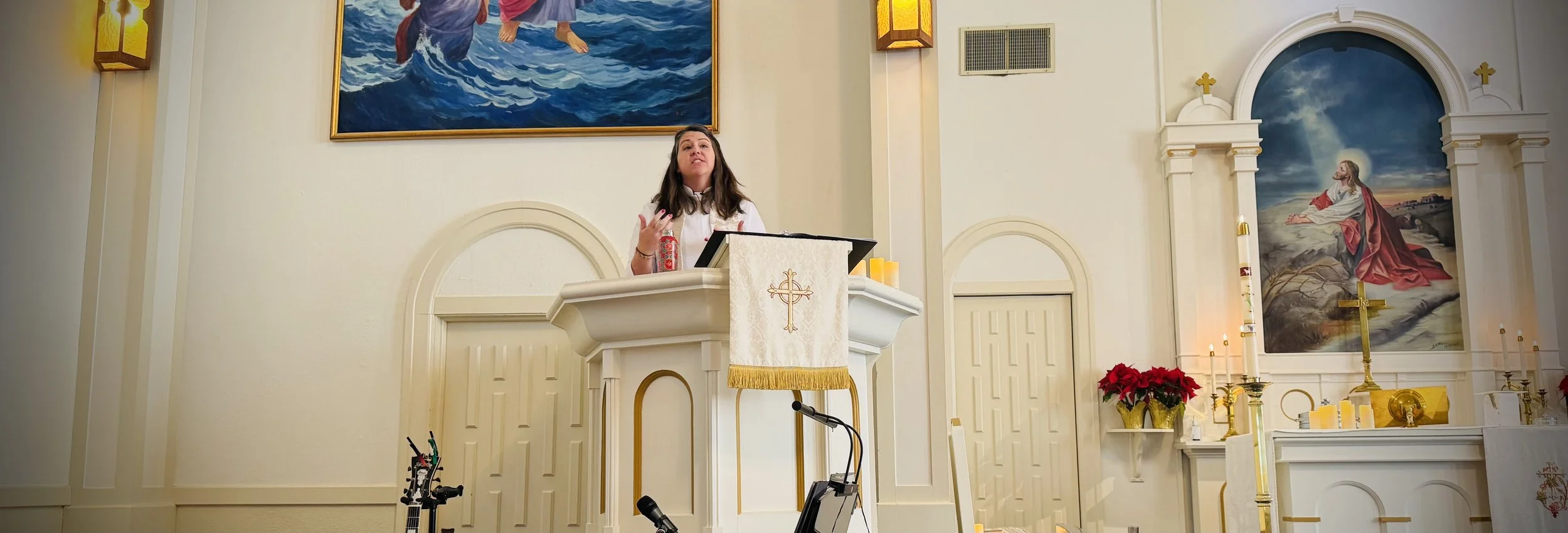
January 11• 2026 Sermon
- Rev. Dr. Mandy Todd
“And here is the good news, People of God: We wade into that water too. We emerge and arise too. Every time we pass by the font in the narthex, we're reminded that God loves us. Every time water streams from the faucet as we wash our hands, we're reminded of a community that stands with us. Every time we take a drink from a glass of water, we're reminded that Jesus stepped into the water in solidarity with us - God with us - to do the hard, hard work of renouncing evil every day.”
Scripture & Sermon at Messiah Lutheran Church
January 11, 2026
Matthew 3:13-17
Then Jesus came from Galilee to John at the Jordan, to be baptized by him. John would have prevented him, saying, “I need to be baptized by you, and do you come to me?” But Jesus answered him, “Let it be so now, for it is proper for us in this way to fulfill all righteousness.” Then he consented. And when Jesus had been baptized, just as he came up from the water, suddenly the heavens were opened to him and he saw God’s Spirit descending like a dove and alighting on him. And a voice from the heavens said, “This is my Son, the Beloved, with whom I am well pleased.”
Sunday, January 11, 2025 Service Bulletin
SERMON - Rev. Dr. Mandy Todd
For hundreds of years upon baptizing a person, the Church has asked the one being baptized (or their parents) a series of questions that sound something like this:
Do you renounce evil and all the forces that defy God?
Do you renounce the powers of this world that rebel against God?
Do you renounce the ways of sin that draw you from God?
Those questions are answered emphatically, "I renounce them. I renounce them. I renounce them."
To renounce something means that you reject it. You abandon it. You can renounce your inheritance, and you can renounce the use of drugs or alcohol.
But we know from experience, and from Luther's Small Catechism, that this renunciation isn't simply a one-and-done affair. The Christian life is a daily return to baptism. Everyday, we must do the work of "emerg[ing] and aris[ing] to live before God." And this daily work of emerging and arising is necessary because evil keeps showing up, every day to tempt us and we must renounce it daily.
In our Gospel reading today, Jesus comes down to the water where John the Baptizer is, and Jesus asks John to baptize him. This is a moment that is captured in all four of the gospels, Matthew, Mark, Luke and John, so we know it's an important moment. In Matthew's gospel, we jump from the Holy Family fleeing Herod in chapter 2, to this moment in chapter 3. We don't know how old Jesus was when the family returned to Nazareth. We don't know how long Jesus was a refugee in Egypt. We don't know where or how Jesus grew up and learned to do his work. The next thing we get is this scene of John baptizing people, and Jesus showing up at the river. Jesus is about to embark on his public ministry. This is a big deal.
But it's kind of weird, right, that Jesus would need to be baptized? I mean, John definitely thinks it's weird. Jesus is the SON OF GOD. He doesn't need to be saved. He doesn't need to get a ticket into heaven. So John is like, "dude, what are you doing here? You don't need to be baptized by me. If anything, I should be baptized by you."
And Jesus responds, basically, "John. Just do it."
And so, John does it. And the heavens open up, and the voice from heaven proclaims God's love and pride in Jesus.
I think there are a lot of reasons why Jesus might have needed to be baptized by John. The text says it's "to fulfill all righteousness." I'm not sure I understand that line exactly, but let me give it a shot.
Soon after this moment of baptism, Jesus is going to go into the desert for 40 days and be tested. The tempter will offer material goods and power and privilege, but Jesus will reject - he will renounce - all of it.
That's hard work. It's hard work to renounce evil today, and I'm not starving in the desert. I can only imagine what that was like for Jesus.
So maybe he needed that baptism by John to help him remember that he could renounce evil.
Maybe Jesus, like all of us, needed that daily emerging and arising too.
Maybe Jesus, like all of us, needed to know that he wasn't alone in this hard work. Everyone who went down to the river to be baptized before him, and everyone who came after him was doing that hard work too.
Maybe Jesus, like all of us, needed to hear God's love for and trust in him proclaimed as he embarked on his mission and ministry.
Maybe Jesus, fully divine and fully human, was just like everyone who has ever come to the water - in need of the love of God in order to do the work of God.
Jesus wades into the water and he emerges and arises from that troubled water ready to do the hard work he's called to do, with the reminder of God's love as close to him as the nearest pool, well, or river, ready to renounce the evil that persists in the world.
And here is the good news, People of God: We wade into that water too. We emerge and arise too. Every time we pass by the font in the narthex, we're reminded that God loves us. Every time water streams from the faucet as we wash our hands, we're reminded of a community that stands with us. Every time we take a drink from a glass of water, we're reminded that Jesus stepped into the water in solidarity with us - God with us - to do the hard, hard work of renouncing evil every day.
And so even when we're tempted in the desert by material goods and power and privilege, we can proclaim these words once again:
Do you renounce evil and all the forces that defy God?
I renounce them.
Do you renounce the powers of this world that rebel against God?
I renounce them.
Do you renounce the ways of sin that draw you from God?
I renounce them.
When we are faced with empirical forces that would turn us away from the Kingdom of God, we can resist tyranny and proclaim these words again:
Do you renounce evil and all the forces that defy God?
I renounce them.
Do you renounce the powers of this world that rebel against God?
I renounce them.
Do you renounce the ways of sin that draw you from God?
I renounce them.
When we are being crucified for healing the sick, including the outcasts, protecting the most vulnerable, and pushing back against corrupt authorities and bullies, we can proclaim these words again:
Do you, will you, renounce evil and all the forces that defy God?
I renounce them.
Do you, will you, renounce the powers of this world that rebel against God?
I renounce them.
Do you, will you, renounce the ways of sin that draw you from God?
I renounce them.
Do you? Will you? Will we?
This is the calling of our baptism. Then, now, and everyday.
Wading into the water with Jesus, we renounce the evil in this world, and we look for the resurrection and the life that comes in our daily emerging and arising. Let's make it so.
In a minute, we're going to sing together Wade in the Water, an African American spiritual that was used as a code song of the Underground Railroad. These code songs offered coded messages that could thwart the corrupt authorities who attempted to capture enslaved people seeking liberation. The refrain, "Wade in the Water," which today we'll sing together, instructed folks to travel through rivers to hide their scent from tracking dogs. I'll sing the first part of the verse where it says leader, and then you'll join me on the second part where it says all. As we sing, pay attention to the way the verses focus on the leadership of Moses (the Israelite), the community of faith that gathers with him (the band dressed in red), the presence of God in the Holy Spirit, and the redeeming power of this journey into the troubled waters.